
Whole Communities–Whole Health Team Turns HVAC Dust into Tool for Tracking Viruses
In the early months of the COVID-19 pandemic, when much of campus had fallen quiet, a small team of UT researchers began looking for viral clues in an unlikely place: the dust collecting deep inside a dorm’s air-handling units. With permission from the University, they vacuumed dust from the hidden corners of a residence hall they jokingly dubbed “Voldemort” — i.e., “The Building That Must Not Be Named,” as any Harry Potter fan would recognize — a nod to the privacy protocols in place.
The goal was simple: find out whether heating, ventilation and air conditioning (HVAC) filters could reveal how a virus moves through a large building.
The stakes were practical. In places like hospitals, dorms and long-term care facilities, knowing that a virus is present somewhere in a building is not enough. What matters is whether it can be narrowed down — to a wing, a floor or a ventilation zone — in a way that makes it possible to act on that information.
‘The Lungs of the Building’
What the team uncovered became the foundation of a study recently published in Building and Environment. Led by Civil, Architectural and Environmental Engineering professors Kerry Kinney and Atila Novoselac, research scientist Juan P. Maestre and postdoctoral researcher David Jarma, the researchers showed that HVAC filters can serve as a building-level surveillance tool. By analyzing dust collected over weeks of operation, the team detected fragments of SARS-CoV-2 and estimated how the virus may have been distributed across different zones of a multi-story residence hall.
“The HVAC system is like the lungs of the building,” Jarma said. “By pulling out the pollutants from the filter, it’s pretty representative of what the occupants are breathing in while they’re inside the building.”
Before COVID-19, Kinney’s group had been developing what they call filter forensics — work that would make the study possible. With support from the Department of Housing and Urban Development (HUD) and Whole Communities–Whole Health (WCWH), her team collected dust from nearly 100 Central Texas homes to study microbial and chemical exposures. “That was a great place to see what types of microorganisms and chemical pollutants people are being exposed to,” Kinney said.
“The HVAC system is like the lungs of the building. By pulling out the pollutants from the filter, it’s pretty representative of what the occupants are breathing in while they’re inside the building.”
— David Jarma, Cockrell School of Engineering
Those projects revealed meaningful patterns, some expected and others less so. Surprising: Dog ownership was linked to healthier indoor microbiomes. Less surprising, unfortunately: the phthalate DEHP, a plasticizer that at high levels has been linked to “a whole host of health problems,” as Kinney put it, was detected at some level in nearly every home sampled (a finding common in many U.S. houses).
When the pandemic struck, that earlier work suddenly pointed to a new possibility: If a household filter could reveal long-term exposure in a single home, could large building filters reveal signs of viral activity across dozens or even hundreds of rooms? “We started thinking about how we could extend this to look in really large buildings,” Kinney said.
Dense indoor environments — dorms, hospitals, long-term care facilities — posed exactly the kind of challenge where new tools could help. “Voldemort” became the perfect test case, in part because Whole Communities–Whole Health helped the team secure access and coordinate the work. “We would not have been able to do the work without WCWH,” Kinney said.
The Virus and the Ventilation
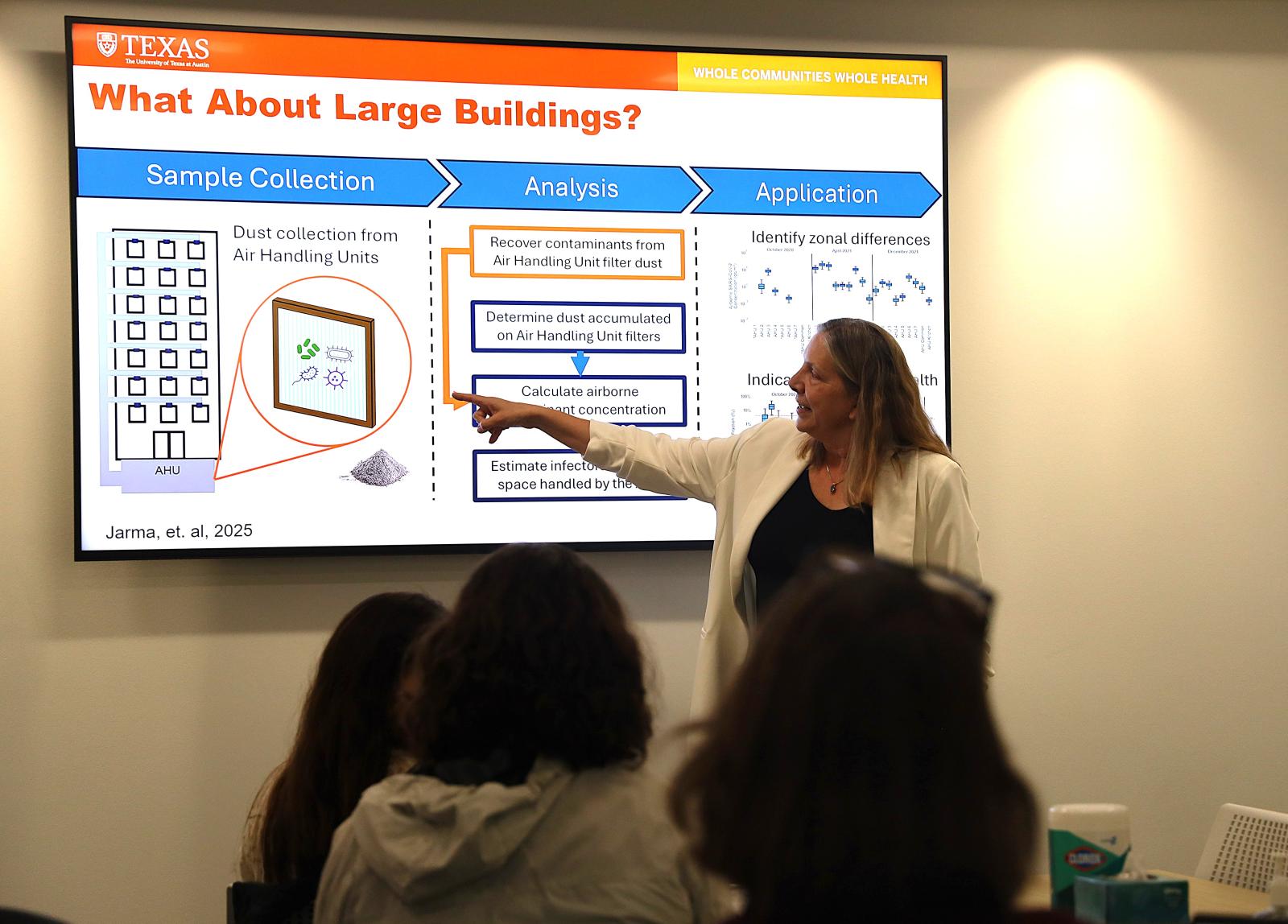
Working with Novoselac and Maestre, Kinney’s team collected dust from nine air-handling units (AHUs) from different zones of the dorm. Each AHU circulated air through roughly 140 rooms, allowing the team to see whether viral signals varied from one part of the building to another without having to test individual spaces.
A high-throughput KingFisher extraction system housed in psychology professor Frances Champagne’s lab allowed the team to process many samples quickly. Then, using machines at UT's Genomic Sequencing and Analysis Facility, the team conducted a qPCR analysis, a laboratory method that detects and measures tiny fragments of genetic material.
From there, the engineering challenge began. By calculating how much air passed through the filters each day, Jarma estimated the average airborne concentration of SARS-CoV-2 in each zone over a two-month period. Those estimates aligned reasonably well with local positivity rates at the time, corroborating meaningful differences from one zone to another.
“If you’re running a hospital and you say, ‘Oh, (the virus) is somewhere in the building,’ that’s not useful. But if you can isolate this to a zone within the building, that becomes actionable.”
— Kerry Kinney, Cockrell School of Engineering
For Kinney, that insight is what makes the approach valuable. “If you’re running a hospital and you say, ‘Oh, (the virus) is somewhere in the building,’ that’s not useful,” she said. “But if you can isolate this to a zone within the building, that becomes actionable.”
The method also has potential beyond COVID. Some viral signals can persist in dust long after the pathogen is no longer infectious, so the same molecular techniques could potentially be applied to other viruses or even chemical pollutants. As long as a target leaves a detectable signal, the filter can capture it.
Just as important, Kinney said, is how those findings are shared. She recalled writing an early report for a community partner that read more like an academic paper than a public-facing document. Sharon Horner, a School of Nursing professor and WCWH team member, “took a red pen to it, because I wrote it like a Ph.D.,” Kinney said, laughing. “And that’s a lesson that has stuck with me: learning how to convey our findings in a way that makes it empowering to communities.”