Seed Grant Projects
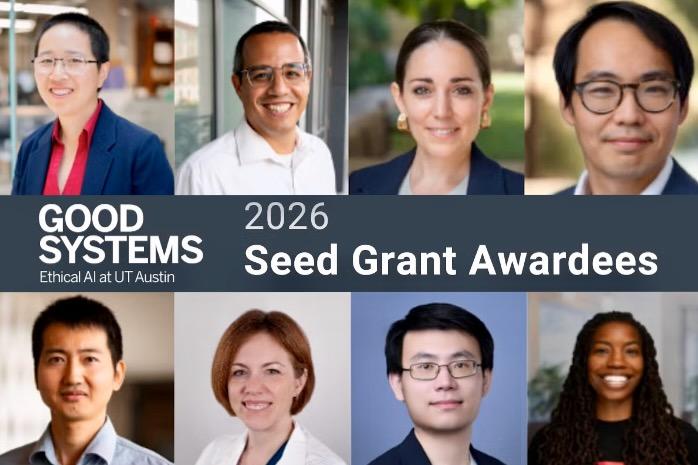
In 2026, Good Systems awarded seed funding to six interdisciplinary faculty teams whose projects explore how artificial intelligence can be designed in ways that better reflect human values and societal needs. The selected projects bring together researchers from 10 schools and colleges to define, evaluate and build AI-enabled systems that are fair, transparent, accountable and responsive to the communities they affect.
Addressing Maternity Care Deserts
Quantifying Multi-Level Health Care Access to Optimize Resource Allocation with AI
This project uses AI and spatial analysis to better understand and address gaps in access to maternity care across Texas. By combining large-scale health, geographic and demographic data, the team will develop tools to identify underserved areas and simulate how changes in healthcare capacity affect outcomes.
Using reinforcement learning, the system will model resource allocation strategies under real-world constraints, helping policymakers and health systems make more informed, fair decisions about where to invest in care.
Team Members
PIs
Yuhao Kang
College of Liberal Arts
Lorie Harper
Dell Medical School
Co-PI
Hyeun Ah Kang
College of Pharmacy
Key Personnel
Rajesh Reddy
Dell Medical School
AI2
Ancestral Intelligence and Artificial Intelligence for Flood Mitigation
This project reimagines AI-driven flood mitigation by integrating Indigenous knowledge and perspectives into the design of predictive models. Focusing on Native American tribal lands, the team will develop an AI framework that evaluates flood management strategies while accounting for local environmental, cultural and community contexts.
By combining planning, policy and AI expertise, the project aims to create tools that better reflect diverse worldviews and support more effective, culturally grounded decision-making in the face of increasing flood risk.
Team Members
PIs
Lidia Cano Pecharromán
School of Architecture
ChangHoon Hahn
College of Natural Sciences
Autonomous Vehicles and Artificial Intelligence for All (AVAIL)
This project explores how AI can support safer, more accessible mobility for blind and visually impaired individuals in environments shared with autonomous vehicles. Through participatory design and collaboration with the Texas School for the Blind and Visually Impaired, the team will develop a portable system that translates real-time traffic and vehicle data into audio and haptic feedback.
By integrating engineering, AI and design, the project aims to improve situational awareness, build trust in emerging transportation systems and ensure that next-generation mobility is inclusive by design.
Team Members
PI
Zhaomiao Guo
Cockrell School of Engineering
Co-PIs
Wen (Vivian) Ye
College of Fine Arts
Qixing Huang
College of Natural Sciences
Hack the Camp-us
Sociotechnical Interventions by and for People with Disabilities
This project develops AI-informed, community-driven approaches to improving accessibility across UT Austin’s campus. Working with disabled students, staff and community members, the team will document lived experiences of inaccessibility and translate them into datasets and design principles. These insights will inform AI-supported co-design tools to generate and evaluate assistive solutions, while also shaping a cross-disciplinary curriculum on disability-centered design.
The goal is to move beyond one-off fixes toward scalable, long-term infrastructure and more inclusive systems.
Team Members
PI
Lillian Chin
Cockrell School of Engineering
Co-PIs
Patrick Benfield
College of Natural Sciences
Leah Chong
Cockrell School of Engineering
Angela Standridge
School of Social Work
Jo Hsu
College of Liberal Arts
Emily Shryock
School of Social Work
DiMitri Higginbotham
College of Fine Arts
Alison Kafer
College of Liberal Arts
Sandy Magaña
School of Social Work
Earl Huff, Jr.
College of Natural Sciences
Knowledge-Informed Multimodal Responsible AI for COPD
This project develops more transparent and reliable AI models for chronic obstructive pulmonary disease (COPD) by integrating clinical, imaging, genetic and environmental data within a causal framework. Rather than relying on opaque pattern recognition, the team will design models that reflect underlying biological relationships and support interpretability and fairness across patient groups.
Using large-scale longitudinal datasets, the project aims to improve both predictive performance and clinical trust, while advancing methods for responsible AI in complex healthcare settings.
Team Members
PI
Edward Castillo
Cockrell School of Engineering
Co-PIs
Hairong Wang
Cockrell School of Engineering
Ying Ding
College of Natural Sciences
Youth Perspectives on Text-to-Image AI
Co-Designing Ethical Generative Technologies for K–12
This project engages K–12 students as co-designers in evaluating and shaping text-to-image AI tools. Through a series of participatory workshops, students will explore how these systems represent their ideas, identify limitations and biases, and develop recommendations for more ethical and effective design.
By comparing human-created and AI-generated work, the project examines how young people understand and use generative AI, with the goal of informing both technology design and educational practice.
Team Members
PI
Angela Smith
College of Natural Sciences
Co-PI
Patricia Abril-Gonzalez
College of Education